Monday, February 06, 2006

Trust no one.

I would like to thank people for sending in information to this blog. It's great to know I have some support from the Rugby populous.

The email address for submissions is at the bottom of the right hand column should you with to send in any relevant information. Don't worry, I am very discreet.

I never cease to get amazed at the information that lies out there in cyberspace and if it were not for the extra eyes and ears I would not have become once again gobsmacked when reading things like this..

  • READ THIS


  • Sunday, February 05, 2006

    The Cement Production Process.. in a nut.

    We live in a concrete world. For along time now concrete has been the most common material used in construction. Cement is merely the binding agent enabling the formation of concrete. There are several different types of cement, the most common of which is the bog standard Portland cement (OPC). It's a grey powder obtained from grinding cement clinker. Clinker is a bulky material with a low value to weight ratio. This makes it really expensive to transport over long distances. To minimise transport costs most cement plants are located close to the source of raw materials.

    Want to know more about the process?

  • If so Click Here
  • Saturday, February 04, 2006

    Read It And Weep

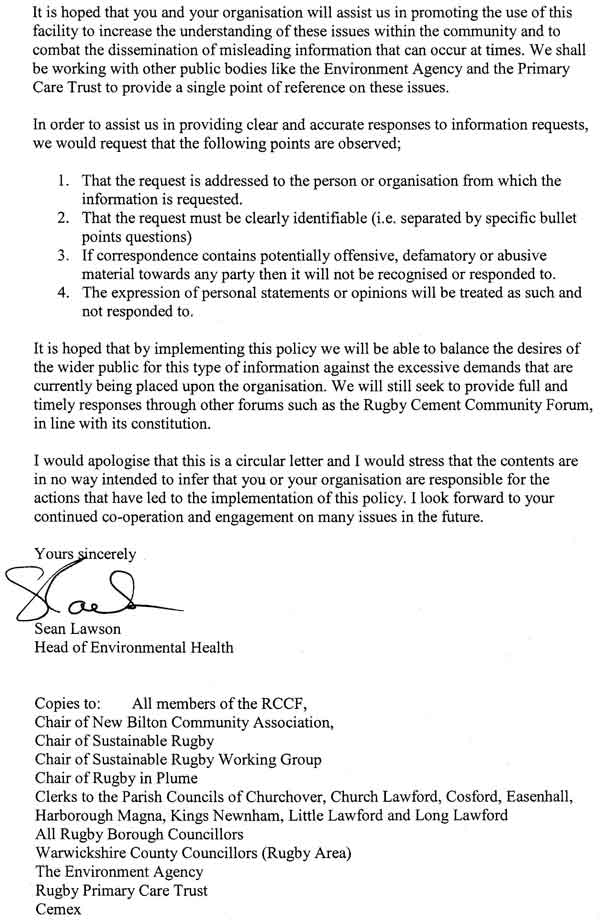
    Please click on the letters to read them


    ..and also this page

    Friday, February 03, 2006

    Things to read

    Here are some important things for you to take the time to read...

    If you value your health.. ;)

  • Castle Cement


  • Edwards Vs The Enviroment Agency


  • 'Air Quality' issue 100
  • Another Cartoon


    Click the pic to make it bigger

    Cemex.. Over-confident?

    Cemex over-confident tyre burning to be permanent.

    Today's Rugby Advertiser, under the heading 'Firm confident tyre-burning will be resumed permanently' is more than a little over-eager, and rather premature, as first Cemex has to get its data quality assured, and then to pass it by the eagle eyes of the Rugby Residents Tyre Burning Review Group, who never miss a trick.

    Among other spurious claims about the air quality improvements guaranteed to be brought to Rugby residents by the increased burning of wastes, is the false claim that protesters have "lost a high court battle" on the matter. It is true that the Judge did not withdraw the IPPC Permit (Integrated Pollution Prevention and Control) - see the link to the full Judgement - but he did find against the Environment Agency for serious shortcomings in their public consultation procedure. These "shortcomings" adversely affected the quality of the information given out to Rugby people at the various large public meetings in 2001/2002, allowed the red-herring of "tyre burning" to hold sway, and affected the reliability of the air quality monitoring in Rugby. Mr Edwards, champion of Rugby people, and his team of lawyers have successfully appealed against the decision of the learned Judge not to quash the permit, and the case will be heard in the Court of Appeal on Monday 6th February.

    This is a massive Public Interest case that will have repercussions for environmentalists, for Environment Agency officers, for air quality and for health, all over the UK. It promises to be a thrilling court room drama.

    Rugby residents are hopeful for a positive verdict, and a brighter, cleaner, plume-free environment, in which to bring up our children, and in which the whole town can thrive out from under the shadow.

    The sun will shine through once again in Rugby!

    Thursday, February 02, 2006

    RBC = OAP ?

    Leading officers from RBC have this week had to suffer the indignity of admitting to ailments usually the preserve of the elderly. One head of department (on a very large salary thanks to us) admitted she (very conveniently) could not remember anything about what happened all of six years ago, while another admitted that not only have they not kept a full, accurate and complete record, a chronological order of events, but also that everything was all mixed up. After charging yours truly £80 for a supposedly "full copy" of the Rugby Cement Public register which they have to keep by Law, it was found to have gaping holes in it.

    Two simple and direct questions have brought on this sudden attack of amnesia and muddle. Firstly we asked them for copies of the Rugby Cement 1999 IPC Application (Integrated Pollution and Control), advert, files, and responses from the Public, and from RBC, to the mandatory consultation. This caused apoplexy. And secondly we asked for copies of all the Rugby Cement Community Forum Minutes and relevant answers and reports to questions that arose. AAAGGH! They cried, and retreated to their nursing homes.

    Unfortunately that last bit is a porky, and they still hang out on full pay at the Town Hall, busying themselves by organising "secret air quality meetings" with a hand picked bunch of councillors, who are definitely all "green", if not all cabbage looking.

    (p.s. Keep your eyes glues to ebay as in the not to distant future you may be able to grab youself a bargain air quality monitor...)

    Wednesday, February 01, 2006

    The Burning Question

    Health Impact Assessments Incorrect?

    The 2002 Health Impact Assessment carried out at Rugby (see link on RIP site) was and remains totally inadequate and did not even then use the correct emission limits for the cement plant, or the correct quantities, there has been a huge year on year increase.

    The burning question Rugby residents wish to ask, as the plume, whether visible or invisible, grounds on them, is how much do the toxic emissions of such like as mercury, cadmium, thallium, dioxin, arsenic, sulphur dioxide, nitrogen dioxide, particulate, etc improve their health? What daily dose is recommended by these Health Experts? Or are the people of Rugby so strong that these things have no effect at all?

    Are Rugby residents a super-resistant race?

    Some residents under the plume don't believe the results.

    Death Row?

    This article could sadly be the future for Rugby Residents that have been duped into buying land on or near toxic ground...

    Parents to sue council over land contamination

    The parents of 30 children who were born with malformed limbs have won the right to sue Corby Borough Council over the toxic contamination of the area.

    Following a successful application to the High Court in London, they have begun a legal action which seeks to establish that the council's mismanagement of clean-up works at former steel-making sites in the town between 1985 and 1999 caused the birth defects.

    Corby was once a hub of the steel industry, but when the industry went into decline, the local authority was left to clean up the contaminated sites.

    Hospitals in the area noticed a higher-than-normal rate of babies born with without fingers and other defects such as webbed hands and feet, prompting parents to take action. Figures suggest the rate of upper-limb abnormality in Corby is 15 times the national average.

    The case has been working its way through the legal system since 2002. The parents believe that the excavation and transport of toxic waste containing lead and zinc-based by-products from the former steelworks to as many as 16 separate waste pits in and around the town caused the birth defects.

    In November 2005, Lord Chief Justice Phillips finally permitted the claimants to enter a class action, which will be led by Collins solicitors.

    Cement Works To Be Shutdown!!

    Sorry to disappoint you guys, but it's not the Rugby plant - not yet anyway!

    If anyone is wondering why I am spending so much time on these issue, take a look at the puny 100,000 tonne a year Barnstone cement works, in a village, being shut down for breaching air quality limits.

    Then pause a while to consider what the 2,000,000 (yes that's right 2 million) tonne a year Rugby plant is doing to the air in Rugby. And where is the only sulphur dioxide monitor located in Rugby? At the Webb Ellis football ground about a kilometre south of the plant. That makes a lot of sense, assuming you do not want to record sulphur from the works, being so far away, and to the south when the wind from the north is less than 5% per year, and predominant wind direction is westerly and south westerly. People in New Bilton frequently complain about smells - is it sulphur they can smell?

    Full story here...
    Air quality breaches force closure of Lafarge cement kiln Lafarge Cement is to close its kiln at Barnstone after numerous breaches of air quality objectives for sulphur dioxide led the local council to declare an air quality management area around the site.

    Lafarge's Barnstone works is thought to be the first industrial process to close as a result of the local air quality management regime.

    The relatively small kiln, which has a 100,000 tonnes per year capacity, makes cement for specialist applications. It is now scheduled to close in May, although Lafarge will continue to blend and package cement at the site.

    Under local air quality management, councils review pollution levels and declare an air quality management area (AQMA) if objectives for one or more of a range pollutants are likely to be missed. Some 150 AQMAs have been declared, mostly relating to road traffic emissions - and only a handful have been driven by industrial sources (ENDS Report 362, pp 28-31 ).

    Barnstone makes a quick-drying calcium sulphate aluminate cement called "Rockfast" for the mining and construction industries. The kiln releases high concentrations of sulphur dioxide. Under Lafarge's IPPC permit, issued by the Environment Agency, the kiln is currently permitted to discharge up to 8,000mg/m3.

    In September 2004, Rushcliffe Borough Council concluded a year-long air quality monitoring exercise around the kiln, finding numerous breaches of the three air quality objectives for SO2:


    The 15-minute mean objective of 266æg/m3 was exceeded on 1,450 occasions. Peak 15-minute concentrations were more than seven times higher than the objective. From the end of 2005, the objective is not meant to be exceeded more than 35 times per year.

    A one-hour mean objective of 350æg/m3 was not to be exceeded more than 24 times per year from the end of 2004. Some 294 breaches were recorded near the Barnstone works.

    Finally, a 24-hour mean objective of 125æg/m3 was due to be met from the end of 2004, with no more than three exceedences per year. The council recorded 32 breaches of this standard.

    Air quality modelling suggested that people in the village of Barnstone were being exposed to SO2 levels exceeding the objectives. In September 2005, Rushcliffe declared an AQMA for SO2 around the Barnstone works.

    As part of the improvement programme under its IPPC permit, Lafarge proposed building a 60-metre chimney stack to improve dispersion at a cost of around £300,000. Modelling suggested this would prevent further air quality breaches. The company also considered fitting flue gas desulphurisation equipment, but this was considered too expensive for the elderly kiln.

    However, obtaining planning permission for the stack proved to be a slow process. Meanwhile, the company fell foul of the Agency, which in May 2005 issued a warning letter following breaches of the 15-minute objective.

    Announcing its decision to close the kiln, Lafarge issued a statement, saying it "has made the strategic decision to end clinker-making [at Barnstone] after a review of projected costs of operation, including rapidly rising energy and raw material prices, combined with costs of continued environmental compliance."


    Lafarge is to invest £20 million in a new gas scrubbing system at its Dunbar site as a result of an improvement programme agreed with the Scottish Environment Protection Agency under IPPC. Lafarge says the system will more than halve SO2 and dust emissions. This will ensure the site complies with local air quality standards and meets the requirements of the EU waste incineration Directive.

    Dunbar has relatively high SO2 emissions compared with other UK cement works due to high sulphur levels in the raw materials.

    full article linked here but you may have to sign in..
  • http://www.endsreport.com/index.cfm?action=report.article&articleID=15245
  • Cartoon

    And another entry for the competition... Keep them coming.
    Don't forget to click on a pic to make it bigger.

    Tuesday, January 31, 2006

    Competition Time!!

    Ladies and Gentlemen, Boys and girls, It's competition time here on the Rugby Town Blog.
    Send in your cartoons so that we can post them on this blog and win yourself £50 lovely pounds...

    You can place as many entries as you want and after we have a good amount online we will find an independant judge to vote for the best cartoon.

    As we have limited space please don't be upset if we don't post yours, we will only be posting the good ones.. ;)

    ..And here is our first entry from Mr X in Hillmorton..

    How to buy off a town

    Check back here to see the gifts/donations associated with the Rugby Cement plant.

    £25,000 a year for three years from 2003 towards air quality monitors. (Who had access to the data? Not the public of Rugby!)

    Here are more examples from 1999, and at that time everyone's eye "was off the ball" as the Council and all the people of Rugby should have been looking at the IPC application for the cement works. (Integrated Pollution and Control) The public were not made aware of the public consultation. Why not? What did RBC do at that time? Their files are mysteriously empty.

  • Gift? info HERE


  • Newbold Shops - £10,000 is being provided by Rugby Cement for the environment enhancement programme.
    Hillmorton Locks - £20,000 is being provided by Rugby Cement towards the refurbishment of buildings at the Locks to create suitable premises for small businesses and visitors.
    Air Quality Project - £15,000 is being provided by Rugby Cement for an air quality project which is also being funded by the Council and the Environmental Agency.
    St Andrew’s Benn Park – The Millennium green - £46,650 is being provided by Onyx Environment. Trust to help convert the disused school playing field into an urban park.
    Great Central Walk - £61,250 is being provided by Onyx Environmental Trust to make the stretch of Great central Walk in the built up area into more of a nature reserve. Other projects have been awarded to the local community in the Rugby rural area by Onyx Environmental Trust.

    Councillor Martin Eversfield, Chairman of the Environmental services Committee said,

    "This is excellent news for Rugby. This is another example of the Council working in partnership with other organisations for the benefit of local people."

    (Ed: "Scuse me while I go get a bucket.")

    Missing Links

    Here is the link to RBC :

  • Rugby Cement Community Forum Minutes

  • It would appear that RBC has "lost" or "temporarily mislaid the attachments".

    We apologise on behalf of RBC who are attempting to locate the missing Documents which lawfully should be a part of the RBC records, as the Committee was set up by them, facilitated by them, chaired by them, and the Agenda, and Minutes are controlled by them. The Council has a Duty of Care, so why this reluctance to give out completed copies of the Agenda items?

    This is anyone's guess, but surely there cannot be something in there they do not wish the general public to see?

    Monday, January 30, 2006

    Agency reassurance not very reassuring.

    Clearly the Enviroment Agency (EA) is trying its very best to reassure people that there are no "extra risks" from burning waste at Rugby, but they have started in the wrong place. First we want to know what the risk is from the coal burning cement plant, before they start "adding in" a few more toxic pollutants. They quote (Committee on the Medical Effects of Air Pollutants) COMEAP in reply to the EA/HPA (Health Protection Agency) request "to consider data collated by the HPA and EA on the effects of emissions of air pollutants substituting Substitute Liquid Fuel and used tyres for a proportion of coke used in specific cement kilns."

    COMEAP reported, "the substitution of Substitute Liquid Fuel and used tyres.. in comparison to the use of COKE as a fuel, is "unlikely" to cause an increased risk to health." Well that certainly makes us all feel better! Where are these plants that they studied located; how many people in the plume grounding area; are they wet/semi-wet process like Rugby where the heavy wet plume grounds easily; how many people did they study; what was the methodology; how many people live in the two kilometre plume grounding area that they studied?

    This report is not relevant in Rugby where COKE is not burnt. Does the EA, or the HPA/COMEAP, have any relevant health studies on the substitution of tyres for COAL in any cement kilns, as opposed to coke? And even more important what about their study of "Rugby town air quality and health without any cement plant emissions", or have they not carried that out yet.

    In the meantime "look behind you" as the Agency have commissioned a Market Researcher to knock doors in Rugby to find out what people really think and experience in Rugby as regards the cement plant. They will be sorry they asked!

    Stack Cam


    I don't know if anyone remembers the wonderful web images produced last year by a local webcam called 'StackCam'..

    The camera supplied by the general public of Rugby allowed us to keep tabs on the plume 24 hours a day 7 days a week.

    Unfortunately the camera ceased to operate when it's location could no longer be used.

    Why don't we get it back up and running? Does anyone have a room with a view of the plume where we could place a video camera and small computer? A broadband connection is also important and I am sure we could find a way of helping out with the costs.

    If you think you can help let me know by emailing stackcam@rugbytown.org

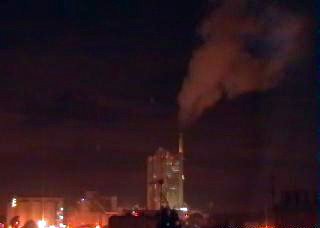
    As you can see by the attached photo, sometimes the plume is much more menacing at night than it is in the daytime.. I wonder why..? ;)

    Saturday, January 28, 2006

    Hear no evil, see no evil, speak no evil

    Today I have been spending yet another Saturday (what a sad and wasted life - I never realised there were SO MANY Saturdays in four years) wondering how all this fits together, and wondering what have I done wrong, and why no "officials of the Council" including my own FIVE ward councillors (Caldecott) will not even talk to me or answer me. I mistakenly thought Councillors were appointed to represent the people of Rugby, but out of the 48 Councillors only one seems to be doing that?

    Can anyone name any Councillors who are doing their job - the job the public pay for? I have asked the following few questions of the Rugby Borough Council Environmental Health Director, Leader of the Council, the Mayor, and all councillors, (we have no Chief Executive, but I believe we are paying one on full-time salary?), and I will publish the reply - if I ever get one?

    Last time I asked a question, (albeit in the Council Chamber where we are told we, the public, who pay their salaries, MAY be seen but MUST not be heard), when they were misinforming the Councillors and people of Rugby, they did not like it at all that I butted in as the public are apparently not allowed to point out "untruths and misinformation", and we are "supposed to sit through it all and take it on the chin". They asked me to "leave the Council Chamber!" Apparently people who speak the truth, the whole truth and nothing but the truth, are not welcome. Maybe I will get an ASBO for speaking the truth out of turn, but they should remember the Three Monkeys: "hear no evil, see no evil, speak no evil!"

    Sent: Saturday, January 28, 2006 4:03 PM
    To: RBC EHO, Leader of the Council, Mayor of Rugby and all Councillors:

    Dear Mrs Stone, Leader of the Council, and Mayor of Rugby,

    On the RBC web site it states that the Air Quality Review and Assessment is open to public consultation until March 15th "2006. Why is the raw/ratified/unratified data not supplied for people to look at? You have supplied the 2003 hourly data and the 2004 data, so how can the members of the public reply, if they have not got access to the essential data?

    1. Where is the RBC Air Quality helpline advertised currently?

    2. Where has it been advertised since November 2003: please list?

    3. What is the telephone number?

    4. What is the email contact number?

    5. You write, at RCCF meeting 25th January 2006, in response to the question "Where is the data from the Stack Cam, and how can the public view it?"

    "The Stack Cam images are not available to be viewed by the public. They are continually recorded through the Council's control centre, which is based in Rounds Garden. Specific software is enquired to be installed on a host computer before the images can be viewed. Images are routinely retained for 7 days, after which period they are erased. When incidents are reported to the Council concerning visual emissions from the stack the images can be reviewed and transferred to a cd-rom for long-term storage. These are available to the Environmental Agency for viewing or other purposes."

    A) How much of the recording (in terms of hours per day) do council officers actually routinely view the stack cam?

    B) Do they only view it when they get complaints from the public?

    C) Do they only view it when they get request from the EA?

    D) Do they view it at all, or just send the "transferred data" on CD ROMs, to the Environment Agency?

    E) How much does it cost to run this "service" each year?

    F) Rugby in Plume managed to record at night: why can the RBC stack cam only record during the daylight hours?

    G) is this good value for money?

    6. Where is the Environment Agency hotline advertised to Rugby residents?

    7. Can you please confirm that any complaints about the plant and the plume should be telephoned immediately to the Environment Agency emergency number of 0800 807060, and also that the persons reporting in MUST ask for the NIRS reference number, so that they get a reply in writing.

    8. Should people also contact RBC to record their complaints, and if so what is the emergency 24 hours RBC hotline number? And the Monday to Friday 9.00 to 5.00 number.

    9. Can you confirm that this plant is allowed to put out black smoke in the "smoke control zone of Rugby" because it has an "exemption".

    10 Can you confirm that the Statutory Nuisance Regulations, as applied to all other industries and persons, do not apply to the Rugby Plant because they have an exemption under the Legislation?

    11 Can you tell us where in the UK or Europe there is any such 2 million tonne a year cement plant, to the west of a town where the wind is predominantly westerly, within a smoke control area in Western Europe?

    12 Why did RBC allow a massive semi-wet co-incinerating cement plant, that has the obvious and uncontrollable plume grounding problems, to be built in a town with no raw materials?

    13 Please list the names of all councillors, and officers, who have agreed to this development.

    14 How much has RBC been paid to agree to this?

    15 What action can the Rugby residents lawfully take against RBC for the damages to the Environment and Health? What route is open to us and what evidence to we need?

    16 Why does RBC refuse to meet with Lilian and members of RIP, and refuse to answer their questions and emails?

    17 RIP lawyers have written to RBC at great length, explaining where and how RBC is failing in its duties, and the reply has been "thank you for your letter - we have put it on file!"

    Thank you.

    Artists Needed.


    Thanks Keith for being so quick sending in this montage..

    At least I hope it's a montage and not some new angle of the cement works I am yet to view. It's called 'Burnin' Rubber'.

    Keep them coming guys, photos, sketches interpritations on what the cement works and air pollution means to you in any format you like.

    Perhaps we could eventually have an exhibition... I am sure Cemex would love to sponsor it.

    Friday, January 27, 2006

    Blog off (Editorial Note)

    If you notice any changes on the site (as in edits) shortly after publishing, this is due to potential misquotes that may have to be removed as we sometimes make the mistake of writing what the big wigs mean and not what they say... Allegedly....

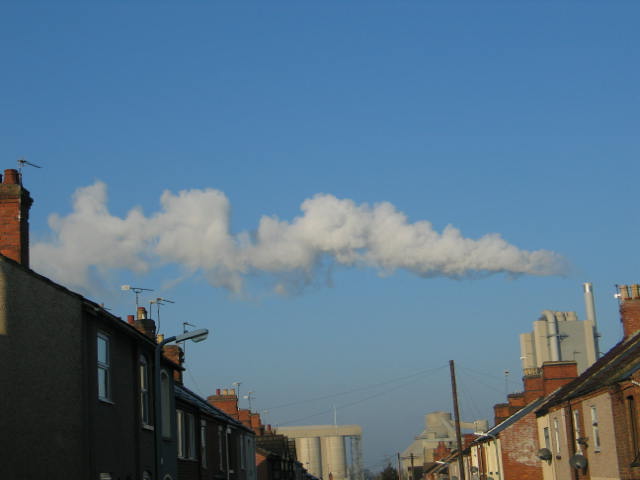
    Here's a pic dated today, thanks go to Squid for seding it in. It looks like the plume is once again straying a little too close to the ground.

    If anyone else sees the plume grounding or looking darker than it should, please send a pic in so we can post it here.

    Thursday, January 26, 2006

    Community Forum

    Last night's forum was as entertaining as ever with the Environment Agency and Cemex admitting that the plume, whether visible or invisible, will ground on Rugby residents, due to circumstances beyond their control - the weather! I do not see why God, and the met office, should get all the blame? Perhaps they should shut the plant when the weather conditions are "favourable to plume grounding", but then again perhaps not! That situation can be even worse as no limits are placed on it at all when it is in the "shutting down" or "starting up" mode as it cannot be controlled at those times.

    Start up is only considered to be complete when the "raw material throughput" reaches 200 tonnes an hour, so theoretically they could be on nearly 5,000 tonnes a day with no Emission Limits! So much for the Agency's claim of "tight limits". The Devil is in the detail as ever. Compare this to the situation of the old works which only made a 1,000 tonnes of clinker a day. The limits must have applied by 50 tonnes an hour at least.

    Air Quality experts were also present to tell us "not to worry" as the air quality monitors show that the plant contributes only 1-9% of particulate pollution in Rugby. They struggled with the maths of it when they realised that on 28/11/05 and 29/11/05 the plume grounding caused the monitor in Addison Road to read 90mu/m3 instead of the background level of 20mu/m3. What percentage increase is that then? Oh they said but that is only for a short term peak. The jury is still out on how much dioxin, mercury, arsenic, VOC etc would have been in the "toxic one metre cubed boxes" as they had to admit that they only know about the daily average and not about any concentrations in each box.

    As ever the interesting questions were left to last, and as "arranged", and as always we ran out of time before getting down to the nitty gritty.